Showing posts with label Faroe Islands. Show all posts

Tuesday, 26 April 2011

Groundhopping in the Faroe Islands


Let’s be clear from the start.  My trip to the Islands was built around the idea of groundhopping, which I did my best to explain to a number of bemused locals during the fortnight.  The English school break for Easter (at least on my patch) coincided with the start of the new Faroese league season, and it turned out that the fixture schedule, together with the relatively small distances involved, would allow me to get to at least nine different venues.  In the end I was able to see twelve games at ten venues in fifteen days.   Knowing that the weather would be variable, I expected to fill in the time between games with a mixture of driving, sightseeing and walking, and so it proved.  Overall, it was an immensely enjoyable experience when taken as a whole.  The football of itself is interesting, sure, but it is its interaction with the physical settings and the friendly “community” feel of the matches that made this such a great trip.

Standards

Without doubt the most common football-related question to me has been, “What are the standards like?”  I have found this difficult to pin down.  Given that the tickets were 80DKK each (about £9.60), the crowds were 400-800 in size, and that the teams are part-time, the starting point for discussion should probably be our Step 2, the Conference North or South.  Let’s imagine a tie between such an English club and a Faroese club played over two legs.  In most cases the Faroese manager would turn out to be the younger of the two.

Within the Faroese teams I saw, there was likely to be a mix of physical shapes and sizes, with the bigger and heavier players in the spine of the team from striker through central midfield and defence to the goalkeeper.  Some of the full-backs and wide-players were, however, more slightly built for speed and agility rather than strength and stamina.  I am pretty sure that any Step 2 English team would be confident about winning at home, on grass, against a Faroese top-tier side.  They would probably have a significant average height/weight advantage and be less likely to be caught out by variable bounce and the dreaded “bobble”.  The experience of the Faroe Islands national side in the Euro 2012 qualifiers bears out the difficulty of the transition (one point from five games, taken at home against Northern Ireland).

If only EB/Streymur could have brought Manchester City here in their Europa League tie ...
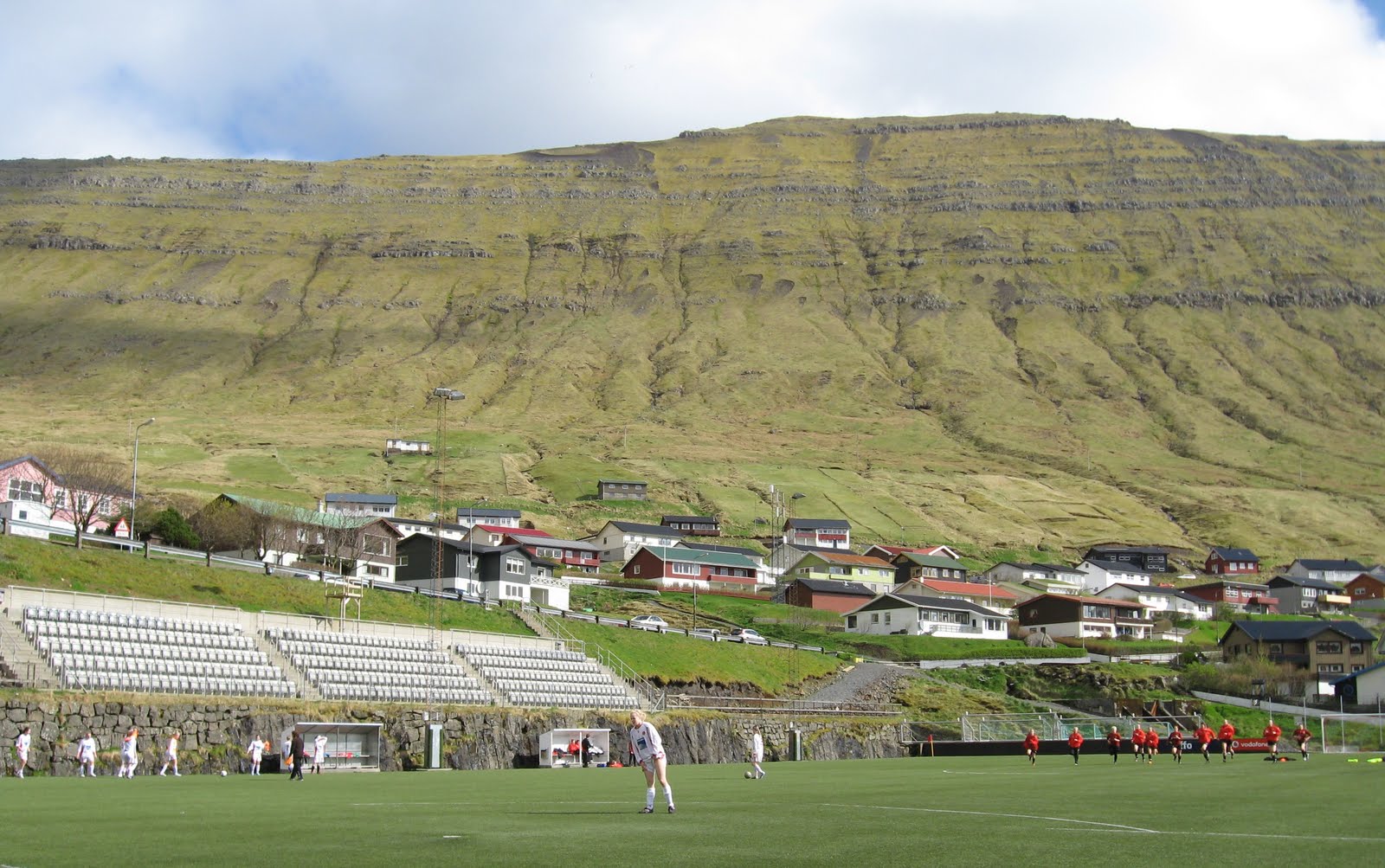
I am less sure about what would happen on the artificial surfaces that are used at all levels of club football in the Faroe Islands.  It is not until you see the relative lack of flat or flattish land in the country as a whole that you realise that it is remarkable that the game thrives at all, and the latest artificial pitches allow community clubs to thrive by running several teams.  (Dynamite was needed to blast a space for the new national stadium at Toftir!)

Some of the most extreme windy conditions that I saw would be a leveller, but on a half-decent day I could easily imagine statuesque English-style central defenders watching in awe as the ball whizzed around in intricate pass-and-move triangles for nimble midfielders and wide players.  Certainly there was no significant difference in the pace of the men’s game in the two leagues, and the games, as in England, often had “cagey” starts and a period of open end-to-end play as the players tired in the last quarter.  I watch a lot of football, as you can see from this blog, and the matches were all, with one exception perhaps, very entertaining.  A reasonable proportion of the men's games still had the result in doubt right up to the final whistle.

The Faroese teams had no problem with using the strong winds to their advantage - I saw a number of goals scored from viciously swinging corners and free-kicks - but the ball spends much more time on the floor.  Defenders are often required to play the ball out from the back.  Front players are most likely to receive the ball to feet with back to goal.  The “lofted ball into the channel” is much more rare (I was wondering whether it is harder to make the ball “hold up” with backspin on the artificial turf) and heading opportunities arise most commonly from set pieces or corners.  It is predominantly a two-touch game - control and pass.  Tackling could be hard, but it is rarer to see a player go to ground.  A mistimed tackle often resulted in a yellow card.

While thinking about standards, it has to be said that the women’s game in England is much more competitive and developed.  One team, KÍ of Klasvík, has dominated the women’s league for the whole of this century, and it looks like it will be several years yet before they will be seriously challenged.

I wonder whether adopting the artificial surface for step 3 and below would really transform the grass-roots game in this country.  I’d like to find out whether Faroese players suffer from fewer knee injuries and can have longer careers.  I wonder how many more younger players could get involved when a club can run several teams on the same patch of land.  How much better could first team training be?  I have listed below the games that took place on one pitch in Tórshavn on Saturday last – it is an undeniably impressive use of a resource.  I am sure that the basic financial mechanics of running a non-league club would be helped immeasurably by the reliability of the pitch, and the levels of winter entertainment for spectators would be improved.

Out of Africa

One other thing that makes the England/Faroes comparison difficult is that there was not a single English (or Scottish, Welsh or Irish) player plying his trade in the league.  The basic issue is that they can probably earn more in the English game, without all the side issues of language and lifestyle.  However, that does not seem to be stopping African players, and to a certain extent some from Central or Eastern Europe, making a mark.  Clubs who bring players in from abroad have to guarantee them a basic income which means they do not necessarily need another job.  The Faroese players are all part-time.  This means that several clubs have black players with “star” status, usually up front or in central midfield, and goalkeepers or midfield playmakers from central Europe are also quite common.  For these players, the Faroese league (currently sponsored by Vodafone) might be a stepping stone to Denmark or the other Scandinavian leagues.

Overseas players make up around 20% of the starting line-up, but in the first two weeks of the season they had contributed more than 20% of goals and assists.

Out of the Faroes

When Faroese goalkeeper Gunnar Neilsen made his debut for Manchester City, it was big news in the Islands that one of their own had made it to the big league.  He had been on Blackburn’s books and has been loaned to Wrexham and Tranmere.  His experience at the moment is the same as many young keepers – he has been on the bench a lot.  Jóan Simun Edmundsson played up front for B68 Toftir and is in Newcastle’s reserves, though he has been loaned out to Gateshead in the Conference.  Neither of them are household names here - yet.

Tórshavn's main shopping centre
The impact of the English Premier League is everywhere in the Islands.  I saw club hats and jackets at every ground I visited.  The big-name shirts are on sale in the city centre, and even a rural bus-stop had a poster for a competition to win tickets to the United-City FA Cup semi-final at Wembley.  The games are shown on TV, a week after the event.  *EDIT: See comment below, happy to be corrected - games are shown live too*  I can’t say that it makes me feel good as an Englishman to find this.
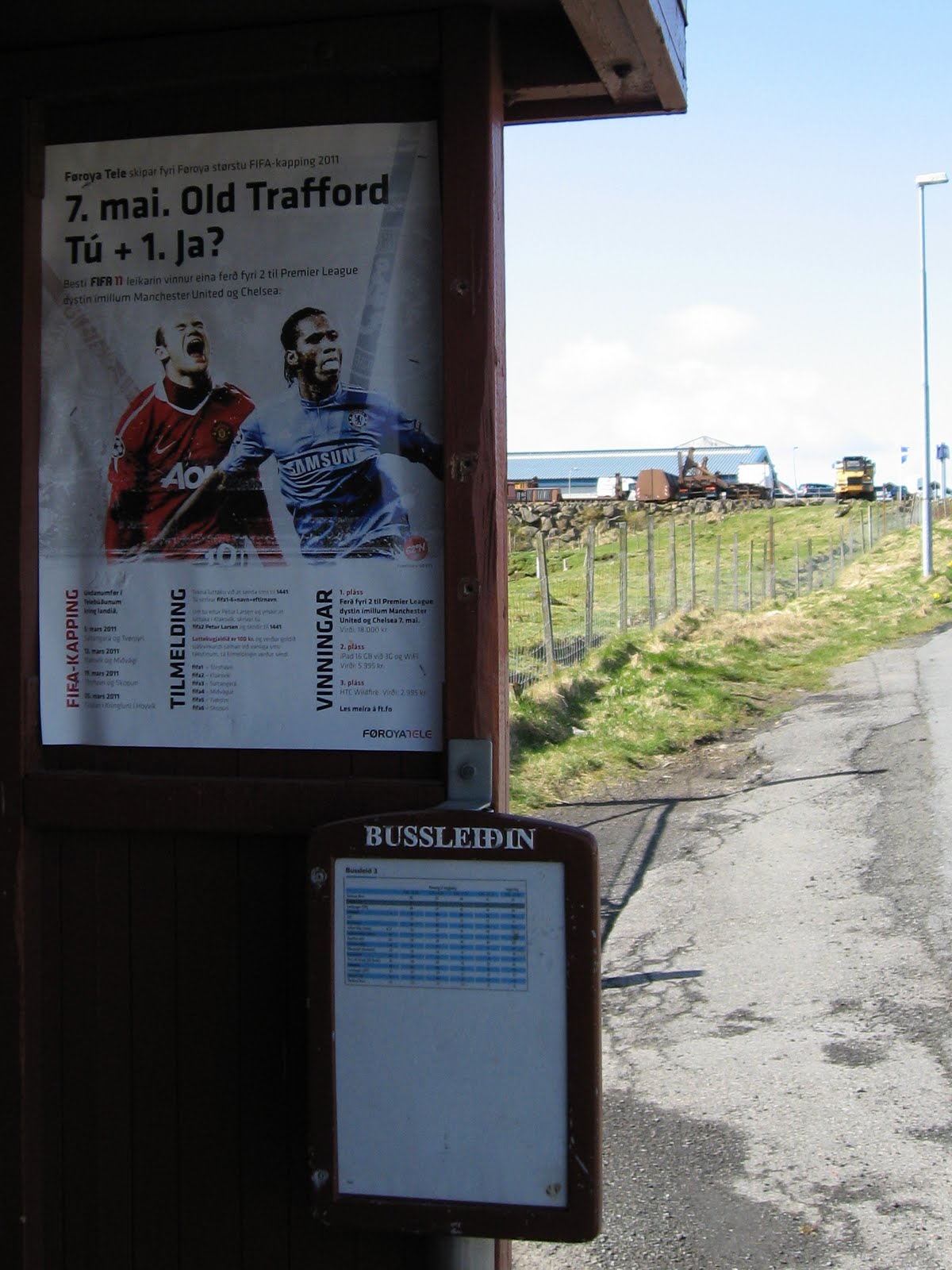
Most of the adults that I spoke to at the games were in touch with Premiership events and had an English team that they supported.  Liverpool more than most, I’d say, especially for the 30-something-plus generation.  There seemed to be more affinity for northern or coastal sides, and the original inspiration was more often than not a prima donna goalscorer.

Atmosphere

Faroese crowds are quiet and polite by English standards.  The latter is no bad thing, to be brutally honest.  Home and away supporters mixed without difficulty, and the makeup of the crowd was much more representative of the population, with a higher percentage of women and children in attendance.  Players were quite likely to apologise to each other after a mistimed tackle, and any dissent to the officials was momentary and covert rather than overt.  Aggression was focussed rather than generic.  The crowds applauded ideas and intention as well as outcomes.

As a percentage of the population the attendances were impressive – remember the entire population of the Islands is about 50,000 meaning that about 5% of them must go to a game in any given week (say, 5 games with 500 present at each).  The same proportion of England’s population of 50 million would be 2.5m people shared among 10 premiership games, or 250,000 at each.  Even sharing among 46 games (92 premiership and league clubs), that would be an average of over 54,000 for each.  Therefore, the per capita support and involvement of the Faroe Islands in football is impressive.  Some of the grounds are geographically assisted in generating the atmosphere of an amphitheatre.


However, the general level of spectator facilities is less than English fans would expect.  Refreshments were usually basic, and signage often poor.  Some of the main stands are still works-in-progress, though they are of a good standard and better than the typical English non-league stand.  Just as here, some clubs are richer than others and have more affluent catchment areas.  The main competing sports, as judged by the newspaper coverage, are handball and swimming, and, at certain times of the year, rowing at sea.


The Bottom Line


Do I recommend this trip for fellow footy fans? Yes. Just Do It.


A Day on the Upper Pitch at Gundadalur, Tórshavn (23 April 2011)
A similar progamme takes place on the adjacent lower pitch.
1000  Training for B36
1130  Boys: HB v ÍF
1300  Boys: B36 v B68
1500  1.deild men (2nd tier) HB v NSÍ
1715  2.deild men (3rd tier) Undrið v AB
1915  3.deild men (4th tier) HB v Giza


Practicalities

Getting Around
I hired a car and stayed at the Hotel Streym in Tórshavn, making full use of their wi-fi each evening for fixture-checking and blogging!  This meant that I drove along the same stretch of road several times during the fortnight, but to be honest the driving was a pleasure and the variations in light and weather meant that I never got bored.  All of the grounds on the six islands connected by roads and tunnels are within 100 minutes of the capital, so these were not long journeys.  I covered about 2200km in a fortnight, and not all for football.  I did not use public transport but it seemed to be reliable and of good quality – whether it would work in practice for groundhopping I could not say.

Tickets and Prices
Top-tier games were a uniform 80DKK to enter (about £9.60) and second-tier games around 50DKK.  There was no problem with ticket availability or with parking.  The locals tend to turn up in the last ten minutes before KO.  Prices of other commodities in the Islands tend to be greater than the nominal UK equivalent - this is not a "budget" destination by any means.

Weather and Activities
I visited at the start of the season in April, and saw everything from sunshine to thick fog to hailstorms.  I would say that three of the twelve matches I saw were seriously influenced for the worse by the wind conditions.  I suppose this proportion would reduce as the season develops.  I found waterproof overtrousers were helpful – and dressing in layers is best.  For April you could well need hat, scarf and gloves too!  Walking off-road for any distance needs the right clothing and footwear.  This is not a place dominated by health-and-safety consultants and the environment and conditions should be treated with the respect that they will demand.  Having said that, every drive was a scenic drive and there are many "Wow!" moments accessible without leaving tarmac.  The weather forecast is available on www.dmi.dk but certainly for my stay, a bit of everything accompanied by stiff SW breezes summed up most days.

Resources
I used the Bradt Guide to the Faroe Islands and Ronaldson’s Directory of Faroese Soccer as my printed resources.  I’d say that the guidebook is essential to get the best out of any visit, and the Directory is useful for working out the recent history (up to 2009) of club mergers and moves.  However, www.faroesoccer.com was far and away the most useful website.  It gave accurate fixture information for the top three tiers of the men’s game and the top two for the women.  Kick-off times move around, and checking on the day is essential.  Club websites remain of variable reliability.

Small Print
All information correct to the best of my knowledge as at April 2011.  All opinions expressed are my own.  Any mistakes are mine.  The value of the Faroese Krone is tied to the Danish one at 1:1 and exchange rates against the pound can go up or down.  Boats adjacent to the Vestmanna bird cliffs can also go up and down, in fact, they will.  Planes landing at Vágar airport can go sideways as well as down, but the pilots are used to it.  Corner kicks at Faroese football grounds can go in any direction, who knows.

Saturday, 23 April 2011

AB One Day I Will See You Again


Hopperational details
Date & Venue: Saturday 22 April at Vika Stadium, Argir
Result:  AB 2  FC Suðuroy 3
Competition:  1.deild (second tier)
Hopping:  The final match of the trip, the twelfth game watched at the tenth stadium.


Pre-match entertainment
An astonishing boat trip to the bird cliffs at Vestmanna.  Although it is not the optimum time of year for spotting the feathered friends, the sheer scale of this place was amazing.  The boat fought against powerful currents as it skirted the cliffs and went into some of the clefts.  This is definitely a must-do-again excursion if and when I come back to these islands.  The still photos just don't do justice to the experience.


This match in one sentence
Heartbreak for AB, back level from two goals down, as they conceded a late goal while pressing for a winner themselves.


So what?
Both teams had won their opening two games of the season.  AB were top of the table but now drop to fourth, FC Suðuroy rise one place to second and are one of three teams with three wins from three.


The drama unfolds 
FC Suðoroy had the better of the early exchanges.  AB keeper Predrag Markovic had to make two good saves, and then AB seemed to be disrupted by an injury to Tróndur Sigurðsson, whose cries of pain were clearly heard as he fell with what looked like a knee injury.  However, both teams were tending to overhit their final pass and it was not until the 25th minute that there was a real near-miss.  AB’s Hallur Fláaberg narrowly missed with a shot that was still rising as it whistled over the bar.  Here's a scene-setting clip from the first half.


FC Suðoroy took the lead after half an hour.  A shot from distance was pushed out by Markovic and Palli Augustinussen showed good awareness in turning the ball square to David Asare who had a simple tap-in.  0-1


The ball was spending more time in the air in this game, and FC Suðoroy tried some real Route One stuff on occasion.  The AB coach Samal Hentze was loud in more than one language, using English as a common foreign language to get a message through to certain players.  They certainly threatened to equalise - a free-kick from Alex Mellemgaard brought a header from Gunnar Haraldsen and a smart save from Stanislav Kuzma in the Suðoroy goal.  However, after 40 minutes Henning Joensen’s shot was saved by Markovic only for Asare to control the rebound and fire home his side’s second.  0-2  There was time for Mellemgaard to send another free-kick just over, and for the yellow-clad referee to wave the matching card three times in quick succession, but there was no more scoring before the whistle.  0-2 at half-time


Whatever Hentze said in the dressing room was pretty effective.  His side had a goal back before he had even reached his seat in the dugout.  Another free-kick from Mellemgaard, and this one went straight in.  1-2


After 55 minutes, controversy.  Kuzma was adjudged to have brought down an attacker as he dived at feet.  He looked very unhappy indeed about the decision, and I have to say I agree with him (I was not far away).  The only other reason I can think of is that he was deemed to have handled just outside the area, but there was no card shown.  Milan Kuljic scored from the spot.  2-2


From then on, AB, playing with much more confidence, tended to take the game to their opponents without creating gilt-edged chances, as shown in the second clip.  They made good use of the flanks and forced a number of corners, but the visiting defence looked solid enough.


The ref waved the yellow card four more times.  The match was petering out towards an honourable draw, when, with two minutes to go, FC Suðuroy caught AB on the break and John Poulsen fired home.  2-3


There was time only for Mellemgaard to pick up a second yellow card for kicking the ball into the hoardings in frustration.  Hentze will not be happy about that.  Final Score 2-3


Closing credits
Firstly to staff at the Hotel Streym in Tórshavn for the room overlooking Nolsoy, the breakfasts, the advice on Faroese pronunciation and the daily football chat.  Each room has its own one-liner, which I loved.  I won’t spoil the others, but this was mine.


Equally important, thanks to the people behind www.faroesoccer.com, without whom I would have had several wasted journeys.  I also acknowledge that they have been my principal source of players’ names for my reports.  The “official” Faroese FA site was slow to get off the mark for the new season, and club websites are still variable.


The two books I used the most were the Bradt guide to the Faroe Islands, written in an engaging style by James Proctor (such as describing trees in a certain cemetery as being straight from an episode of Scooby-Doo) and Ronaldson’s Directory of Faroese Football, which is accurate up to 2009 and helped me physically find a couple of the more tucked-away grounds.


I didn’t make as much progress with the language as I’d hoped.  I spent six months learning some Icelandic in the 1990s and although the language is structurally much the same, the pronunciation is quite different.  However, the experience helped me to read some newspaper reports - slowly!  Almost everyone that I needed to communicate with spoke English to some extent.  If you want to try, there are courses and software available, and all I would say is start in good time.  If you are of a certain age and took Latin at school (because of certain structural features of the language), or were taught the fundamentals of English grammar in a traditional way, then you will have an advantage.  I do sometimes wonder whether this is part of the reason that English players do not travel well abroad.


Learn Faroese through football
Úrslit  result
Áskoðarar  attendance


What Next?
Atlantic Airways to Stansted.  I have had a fabulous and inspirational fortnight, and am sad to be leaving.  Thanks to all of my original blog readers, and to those who have joined my random world in the last fortnight.  I am working on a final summative article to draw together what I have learned and to help anyone who wants to follow in my footsteps.  That will follow next week when my feet are back on the ground.

Friday, 22 April 2011

ÍF only I could think of a witty headline


Hopperational details
Date & Venue: 21 April 2011 at Fuglafjørður Stadium
Results & Competitions:
ÍF Kvinnur 1 HB Kvinnur 5 in the Steypakapping (a knockout-competition)
ÍF 0 KÍ 1 in the Meistaradeildin (top-tier for men)


Hopping:
Two games, one venue.  That now exhausts my possibilities for top-tier games on this trip, meaning that I have been to 8 of the 9 venues in the division (remembering that HB & B36 are ground sharers).  As the fixtures turned out, B71 Sandoy are the team I missed out on seeing, even as visitors.


These matches in one sentence each
HB Kvinnur took a significantly higher percentage of their chances and the challenge from the home team fell away after half-time as Marianna Jacobsen completed an impressive hat-trick.


KÍ scored an early goal and were able to defend their lead while threatening to score again on the break.


So what?
HB Kvinnur go through to a quarter final at home to Víkingur Kvinnur, who had a walk-over in their tie.


KÍ are top of the league after three rounds, with a 100% record, on goal difference from EB/Streymur, who beat 07 Vestur today.  In the other games, HB beat B71 and B36 drew with Víkingur.  Víkingur’s point mean that ÍF drop to 7th after their defeat.


The drama unfolds


In glorious Spring sunshine, and with flags for once hanging limp, HB Kvinnur took an early lead.  Marianna Jacobsen was brought down from behind in the box in the 3rd minute and Rudi Zachariassen converted the penalty, although keeper Hanna Poulsen got a touch.  0-1


Zachariassen's penalty hits the back of the net


The match looked to be running away from the hosts when a second was scored after 11 minutes.  Jacobsen was played through the middle, and she had time to steady herself before finishing with confidence.  0-2


ÍF Kvinnur got one back after 22 minutes through their player-of-the-match, Jensa Olsen.  She flicked the ball over the approaching keeper with the outside of her foot after a good through ball.  1-2  The clip shows some action from the first half.


The game hinged on the last 5 minutes of the half.  After 40 minutes, Zachariassen, who had caused problems throughout the game, burst through the home defence in the left channel and finished superbly high into the far corner for her second goal.  1-3


ÍF should have scored immediately in reply, but a header came back off the post, and there was another clear shooting chance before the whistle.  As it was, HB took a two-goal cushion into the interval.  1-3 at half-time


As the second half began, ÍF pressed forward and Olsen had a couple of half-chances with shots from distance.  Then a flowing HB move involving Steintóra Joensen and Hildur Egilsdóttir led to Jacobsen’s shot creeping agonisingly past the post.  The fourth goal came on 68 minutes.  It was similar to the second - Jacobsen took the central route and was strong and composed as she finished superbly.  1-4


She completed her hat-trick nine minutes from the end with a shot off the bar as the ball fell to her 18 yards out from a corner. In the end it was comfortable enough for HB who won this game without any major scares.  Final score 1-5


Blue & White v Red & White - anyone else getting Subbuteo flashbacks from childhood?
In the following game, table toppers KÍ had the better of the opening few minutes.  One shot fizzed narrowly wide and ÍF goalkeeper Jákup Mikkelsen had to pull off a smart-one handed save from a free-kick.  The visitors duly took the lead with a goal from number 13 after thirteen minutes.   Kristoffer Jakobsen took one good touch on a through ball and scored easily.  0-1


My first clip is timed just after this, as ÍF immediately went in search of an equaliser.  


Mid-way through the half they had two chances in quick succession.  Jan Ellingsgaard hit the bar with a looping shot and Christian Muomaife headed just over.  They left themselves vulnerable to swift KÍ breaks and Aleksandar Jovevic had to take a yellow card for a cynical trip on one such occasion.  The resulting free-kick only led to a corner, which also came to nothing.


KÍ’s Høgni Zachariassen showed that the honourable art of centre-back shooting is alive and well.  Jovevic rolled the ball to him in space and the ball-boy may reach puberty before he finds that one.  As I was trying to count the number of youngsters around me wearing some sort of English Premiership item of clothing, (I lost count), ÍF’s Bogi Løkin had a header pushed away just before the whistle.  0-1 at half-time


The second half started as a midfield shutout, with no real chance of note until the hour mark when another ÍF header went over, this time from Uni Petersen.  The home side had plenty of possession but again they nearly conceded on the break, as Jakobsen set up Bárður Heinesen but only for Mikkelsen to save well once again.  ÍF then forced the KÍ defence into a panicky clearance from the 6-yard box, before Jakobsen missed a great chance for his second goal.


As the final whistle drew nearer, KÍ’s tactics changed and they looked to run down the clock.  Jakobsen limped off after a couple of heavy challenges, and ÍF had one more good chance in stoppage time as a shot went narrowly wide from 20 yards.  The win was greeted joyfully by the travelling support in a crowd of around 500.  My final clip is taken from the dying seconds as I moved back to try to capture the feel of the arena.  Final score 0-1


Post-match entertainment
A drive along the old road from Fuglafjorður to Leirvík in gorgeous sunshine, pausing only to look at the site of the Islands’ only hot spring (well, warm at 18 degrees Celsius) and for the pastry of the day.


Learn Faroese through football
Steward
Hósdagur  Thursday
Sól  Sun
Lot  Light breeze
Fjorðingsfinalur Quarter-final
Hálvfinalur  Semi-final


What Next?
A number of possibilities for Saturday to be investigated which should allow me to visit at least one more venue.  The most likely is Argir for AB’s game with FC Suðuroy in the second tier.  I really don't want to think about the flight back on Sunday, the laundry on Monday, and the in-tray on Tuesday.  As ever, thanks for your interest.  I have tried to explain the concept of "groundhopping" to the local supporters, and they are more than ready to welcome an invasion of English eccentrics.

Thursday, 21 April 2011

Bend It Like A Faroese Corner


Hopperational details
Date & Venue: Wednesday 20 April 2011 at Við Løkin, Runavík
Result:  NSÍ 1 B68 0
Competition: Meistaradeildin (top tier of Faroese football)
Hopping: 8th venue of the trip, 9th match watched


Pre-match entertainment
Quick photo-opportunity visits to a couple of other grounds that I won’t be properly “hopping” to on this tour (to be featured in a future post), some scenic driving (albeit on a foul, wet and windy day), but most bizarrely, finding these items on sale in a service station in Gøta:


My knowledge of the language remains limited, but this is quite clearly a footy magazine featuring Gareth Bale being displayed next to a magazine of erotic writing aimed at women.  Someone will have to explain the connection to me, and probably to Harry Redknapp.  Here's a taldjur, or oystercatcher, to take your mind off this issue.  It's the national bird.


This match in one sentence
B68 failed to score in the first-half and therefore left themselves facing both NSÍ and the wind in the second.


So what?
This was the first game in the third round of matches so league table positions are meaningless until Thursday evening.  For the moment, NSÍ are fourth, and B68 stay eighth but still without a point this season.


The drama unfolds 
The strong wind was this time blowing from end to end, making it likely that this would be a game of two halves.  Both teams struggled with the conditions.  B68, in the red, had the wind behind them in the first half.  The NSÍ goalkeeper, András Gángó, frequently had to take goal-kicks with the ball beginning to roll back towards him.  On a couple of occasions, the linesman allowed him to place the ball a few inches forward of the six-yard line - by the time he had completed his run-up, the ball was in the correct place for the kick.  The trajectory was akin to that of a golf drive, with the ball holding up in the air before falling near-vertically, sometimes still in the defending half.  The first video clip sets the scene.


Nothing much happened in the first quarter.  I filmed B68’s first corner, which was not until the 28th minute.


On the half-hour mark, NSÍ’s Helgi Petersen had the best chance of the game, but his shot was wide.  Overall in the first period, the home team coped well enough with B68’s attempted attacks and they would have been happy with the score at the interval.  0-0 at half-time


NSÍ began to impose themselves in the second period.  B68’s keeper Tórður Thomsen saved well from Petersen, and then he dealt with a cross by Jónhard Fredricksen.  He had been played into space by the impressive midfielder Abdul Ismail, whose strength and distribution was a feature throughout.  At this precise moment of writing, I have just put him into the lead for man-of-the-match on the club website vote.  He was tied with the scorer (see below) until then.


B68 steadied the ship and the next chance did not come until the 60th minute, but Christian Jacobsen’s flicked header from a long throw drifted wide.  Two minutes later they hit the near post with a corner - all corners from that end were inswinging whether you wanted them to be or not.  The goal came on 68 minutes, a cool finish from Jacobsen.  1-0


B68 threw on substitutes including Ibrahima Camara, who had scored in both previous games.  He immediately caused problems with his pace and power.  One of two chances of an equaliser came with nine minutes to go.  Ndende Guéye burst from defence, played a one-two, and had a clear sight of goal, but his low left-foot shot went just wide.  The other chance was from a free-kick, but turned out to be more of a danger to passing seagulls as it went high into the sky.  The final clip is also from the second half.  Final score 1-0


Learn Faroese through football
Mikudagur  Wednesday
Venjari  Manager or Head Coach
Linjudómara  Linesmen
Aelingur  Showers (as in rainfall, not as in changing rooms)
Luftpútufar mitt er fult í álli  Nothing to do with football, but Monty Python fans will understand


What Next?
Tomorrow’s hop will be to Fuglafjørður, where ÍF are at home to table-topping KÍ in one of the four games taking place to complete the third round of fixtures.

Tuesday, 19 April 2011

Just Look at That

A few people have asked to see some more of the scenery from the Faroe Islands - and on this footy-free day, I am more than happy to oblige!  I've chosen one pic from each day so far.  Enjoy.  (Pssst - NSÍ v B68 tomorrow!)


Looking towards Gásadalur

Sandavágur
Funningur
Statue of Effersøe in Tórshavn
Eiði
Saxsun
The bridge connecting the islands Eysturoy (on the left) to Streymoy
Another busy day on the roads in Eysturoy
Klaksvík is an important centre of the Islands' fishing industry
Tjørnuvík

The sea stacks Risin and Kellingin

Monday, 18 April 2011

Ladies and Gentlemen, the Winners are ... KÍ


Hopperational details
Date & Venue: Sunday 17 April at the Injector Arena, Klaksvík
Results and Competitions:
KÍ 3  B68 Toftir 1 (Premier League, top tier)
KÍ Kvinnur 9  HB Kvinnur 0 (Women’s 1.deild, top tier for women)
Hopping:  Two matches but only one venue.


Pre-match entertainment


Scenic drives around the northern islands, with a rainbow en route.


These matches in one sentence each
KÍ were helped on their way to the top of the table by a goalkeeping error for the game’s second goal.
KÍ Kvinnur demonstrated why they are the irresistible force in Faroese women’s football with a demolition of their opponents from Tórshavn.


So what?
Newly-promoted KÍ are one of three teams to have won both their games but they have a superior goal difference and therefore head the table.  B68 are one of three teams yet to win a point.  In today’s other games which completed the second round, EB/Streymur go third with a win at ÍF and B36 are second after their home win over B71.
KÍ Kvinnur have won all three of their games and head their table too.  They have won the league in every year beginning with 2 and looks like they will get their twelfth in a row this year.


The drama unfolds 
This match was played in near-ideal windless and fairly mild conditions!  B68’s defender Niclas Joensen was given an early yellow card for a mistimed tackle as Bárður Heinesen threatened.  KÍ’s keeper Gunnar á Steig was then called into action to make a save from a free-kick as both sides tried to take the initiative.  B68’s Hjalgrím Elltør unsuccessfully tried an outrageous curling free-kick from near the half-way line after 20 minutes.  The sparring continued - a quick B68 corner caught the home defence asleep and led to a headed chance for Ndende Guéye but KÍ immediately countered and only a late block prevented a shot on target at the other end.  Joensen was kept very busy.  The home supporters in a crowd of around 500 applauded every attempted through ball and were warm and encouraging to their team.  My scene-setting clip is taken from the first few minutes of the game.   KÍ are in blue.


Gradually KÍ began to create the better chances.  Bárður Heinesen span away from his marker in midfield and passed to Nenad Stankovic, who was unlucky as his dipping shot bounced up off the bar.  One of several crosses from the right by Henry Heinesen produced a chance for Elltør, but he snatched at the shot and sent it wide.


The deadlock was broken after 39 minutes.  B68 defender Oddur Hgaard and keeper Torður Thomsen failed to deal with a bouncing ball through the middle - I cannot say from where I was standing at the other end whether either or both were at fault - but Bárður Heinesen nipped in to score.  1-0


Both sides had one more chance before half-time.  Joensen headed over from a corner and Elltør brought a good save from Thomsen.  1-0 at half-time


Thomsen was called into action again a few seconds after the restart, but KÍ really should have gone two up.  However, a second goal did arrive after 54 minutes.  A disputed free-kick was given for handball (harsh, I thought).  Høgni Madsen shaped to cross but instead fired it in to the near post.  The photo shows that Thomsen had it covered but somehow he contrived to let it creep in.  2-0


After this, KÍ continued to make chances.  Henry Heinesen created a chance for Kristoffur Jacobsen, who shot over.  Elltør finally got the goal he had been threatening, with a low shot to the corner after 76 minutes.  Cue wild celebrations!  3-0  They nearly added a fourth when Jacobsen pulled the ball back for Jógvan Isaksen whose shot was saved by Thomsen at full stretch.


B68 did get a consolation goal after 81 minutes.  Joensen won the header from a corner and in the ensuing melée Ibrahima Camara got the goal.  However, KÍ saw out the final few minutes to hang on to the points.  Final score 3-1


Sadly, very few people stayed on to watch the top-tier women’s game, which followed on the same pitch.  The first clip is taken from the opening minutes with the score at 0-0.


KÍ Kvinnur dominated from start to finish.  Maria Thomsen has been credited with the first goal, though I thought Sofía Purkhús got the last touch.  It turns out to be important in deciding which of them has a hat-trick.  Thomsen, Purkhús, Sigrid Jacobsen and Rannvá  Andreasen caused all sorts of problems with their combination play up front, and how Jacobsen did not score today she will never know.  She had at least four good chances.  The attackers were supported by a dominant central midfield performance by captain Malena Josephsen, and assured central defensive displays by Paula Mikkelsen and Bára Klakstein.  HB struggled to clear their lines, even from goal kicks, so they were faced with wave after wave of KÍ Kvinnur attacks.


Here’s the chronological record.  I can't really say the drama unfolded, as in TV terms this was about as dramatic as the test card.


Purkhús just fails to get the last touch on Thomsen’s through ball but it goes in anyway.  1-0
Josephsen sets up Purkhús to score.  2-0
Thomsen passes from the left for Andreasen’s first.  3-0
Thomsen’s second, as caught on camera.  4-0


Andreasen’s second, an easy finish after a poor clearance.  5-0 at half-time
A curling shot from 20m by Andreasen to complete her hat-trick.  6-0
Andreasen lays the ball off to Purkhús who finishes.  7-0
Josephsen deservedly gets herself on the score sheet with a well-crafted approach and finish.  8-0
Thomsen completes her hat-trick within a minute 9-0


To be fair to HB, they made KÍ work harder in the second half, but they never closed down Josephsen.  Gunn Mohr Hentze was their most impressive player, with some neat touches going forward, but there was an enormous difference in class and confidence between the two teams.  Home keeper Randi Wardum had very little to do - the first two shots from HB were not until the second half and then they were off-target.  If I have not mentioned the entire KÍ team it is only because the others must have had relatively little to do - they had no weak links in the side.


What I learned today
I encountered single track tunnels today for the first time in my driving experience.  If the passing places, every 100m or so, are on the right, then you have to pull in and wait for oncoming traffic to pass.  This is an example of something that is best NOT left to chance, I guess!


Something random
Sadly, I will miss this but let's hope it tours to London.


Learn Faroese through football
Litið lot  Gentle breeze
Álop  Attack


What Next?
NSÍ play B68 on Wednesday, but I am in search of a youth game on Monday afternoon too.